
You are welcome in the site www.Bicycles in world
here in this web we show you information for those who love cycling , tell me your opinion and i will make sure to make it beter.
This site is dedicated to amateur cyclists. Want to perform for those who love cycling enthusiasts, this site will help you to piece this site contains all the information you need will be written by the benefits of the bike and the names of cyclists all the news here on the site
The benefits of cycling:
Riding a bike helps in maintaining cardiovascular health, having found some studies that people who ride bicycles on a daily or almost daily less likely to develop heart disease and arteries by 50%, and especially the problems of the coronary artery, as well as increase the fitness of the heart muscle TONGS 3% - 7%.Ride a bike burn a large number of calories, and drive for an hour at a moderate pace burns 300 calories, and a lot of fat.
Cycling helps to improve the workings of the brain, and the ability to coordinate and regulate the movement of the parties, it is used as an exercise for the brain.
NOTE: After riding his bike with a few aerobic sports medical conditions such as heart disease or arthritis, so you want to do it and you suffer from health problems such as, you should consult your doctor first.
---------------------------------------------------------------------------------------------------------
The names who have won in some countries:
Israel: Ahmad Zeidan
America: Volkswagen
Types of bicycles are:
cube:

giant:

Strom:
NOTE: You must be a bicycle made of light metal to be better and easier for you, such as carbon metals Aalma your best metal used for the manufacture of bicycles Ao carbon
Before to ride the bike aerobic must make sure that the good health of the bike must wear a helmet and custom basses and should make sure that he have the equipment Asafeeh And do not forget the water because the water is very important for the body
...........................................................................................................................................................
**********************************************************************************
Best videos of the year 2014.2015 to the descent of the mountains:
Polytheism that supported the sport bicycles huge quantities of money:
Red Bull: 

Munster:

Videos movements in aerobic bike:
***********************************************************************************
NOTE: education must start from a young age in the generation of 10-year-old because he is a professional and Mshahurvqt Balbmstqubl will swim that is he wants to learn not to want to leave it because biking Hey Huai since childhood and I - * - *
Bicycles also have disadvantages, it is possible to break you Okahalk helped you or even your neck so Ahterso also from falling. . . The young wanted to RKO for bicycles must be with an adult or competent exposure injury
Cycling is a collection of sports types where bicycles are used for athletic competition. Intervention in the framework of the following varieties cycling race:
Road bicycle racing
Cycling race on the track
Mountain bike race (mountain-bike)
Bicycle racing penetration (BMX) (BMX)
The following inventory [13] of the most important events that marked the evolution of the diverse Basnavha cycling race, since the end of the nineteenth century:
1893: The first world championship cycling on the track.
1896: Inclusion of cycling in my class and the way the track at the Athens Olympic Games summer.
1900: the founding of the International Federation.
1912: the absence of class field in the Summer Olympic Games in Stockholm (and is the only absence of this product in the Olympics) history.
1927: The first world championship cycling on the road.
1950: The first world championship cycling on the track inside the hall.
1965: The International Federation split to University Amateur (FIAC) and other pro (FICP).
1984: The first world championship race bikes barriers (trial).
1988: The first women's participation in Olympic history and the track was in a class during the Seoul Games.
1990: The first world championship race mountain bikes (mountain-bike).
1992: reunification of the International Federation and stability in Lausanne.
1993: The first world championship race bikes penetration (BMX).
1996: The Atlanta knew cycle for professional riders first participation in Olympic history and the adoption of the mountain bike race (mountain-bike) as an Olympic sport.
2008: Adoption of the Bicycle penetration or "BMX" Race (BMX) during the cycle as an Olympic sport
First sports competition cycling was held on 31 May 1868, in the orbit of 1,200 meters and with the participation of seven contestants. The competition was held in one of the gardens Parisian suburb Saint-Cloud [1]. The British won the race James Moore [2] wooden disc bicycle wheels fixed teeth and iron [3].
The year after that will be the first race on the road contemporary sense, on 7 November 1869, between the cities of Paris and Rouen at a distance of 123 km [4]. Beat James Moore, also the race, time 10 hours and 45 minutes. With the rapid development of technology will know bicycle industry, in the second half of the nineteenth century, you'll learn the sport growing in popularity across European soil, and especially in Italy, the Netherlands, France, Spain and Britain. These countries was the forerunner to the establishment of clubs and national federations. Thus the first clubs founded Pflorranza (1870) and the Netherlands (1871) and Cadiz (1878), and founded the first union (the University of) national in France in 1881, and which brought about the first national championship of cycling in the same year. 5
Bike and bike mobility vehicle based on human movement and is working through the payment of pedals positioned in front of the rear wheels through the use of the legs. Contains calves connected the external structure of the bicycle. The bicycle from one of the transportation devices used since ancient times, and considered as a means movement of a single track - that is, it leaves attitude alone on the road that it walks forward. Such vehicles usually have little or no lateral stability of the share in the case of constancy, but their formation during forward movement or during its control. As in the case of all vehicles with wheels, the path taken for each of the front and rear wheels differ very narrowly at the exit of the vehicle derailed rectum.
I found a bicycle in the nineteenth century in Europe, there are about a billion a bicycle on a global scale, superior to the number of cars at the rate of bicycles per car. And it is one of the one of the main means of transport in many regions to the present day, and give a famous way of recreation, where adapted to being a toy for children, fitness, and military applications and the police, courier services, as well as cycling.
The primitive form and specifications of the model bicycle safety, has changed little with the passage of time with the first model fitted with a bicycle chain around 1885 AD appearance. But many of the specifications since then has undergone tremendous changes, particularly with the advent of supplies and modern equipment and designs pro using the computer, operating on the rise and proliferation of specialized bikes for many of the designs.
Date of bicycles
I have asked for access to the final form of the degree that you know today a long time, and passed several key stages. The first perception of form for the Italian artist Leonardo da Vinci back in the end of the fifteenth century, 1493. His idea did not receive attention at the time, and remained forgotten until the end of the eighteenth century. 1791, until the coming of the French Count de Svrak of France, who was credited with the invention of the first bicycle without pedals and steering wheel. It is starting out by paid building on foot, running, dubbed célérifére name
Michaux Jr. on Wlosbd 1868.
Since that time several amendments to the motion system by some of the inventors of them Trifu and inventor German Draas iPhone Samer Brown, who added her steering wheel in 1813 and inventor Mac Milan from Gaul who created the movement system (pedals, and a transmission) in 1839. In 1855 Frenchman Ernest Michaux son Pierre Michaux developed.
Defined
The definition of aerobic bike
And means of transport of the two wheels mounted and connected to the rear wheel Paljnzir which is connected with the place of leadership or the so-called pedal. There is also the seat in which the passenger sitting led. There are bike engine and has a wrap bike to the party that we want. That is, we sum up the installation of the bike:
Ajltan.
Catenation.
Pedal.
The seat.
Engine.
Bike parts
Structure
1 - top tube
2 - tube bottom
3 - the seat tube
4 - the seat pillar
5 - pillar catenation
7 - brakes background
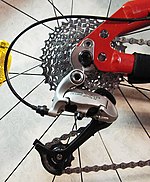
8 - gears background
9 - Venice rear
10 - Venice Front
11 - Track
12 - pedal
13 - Pedal arm
Wheel
14 - Valve
15 - Tire external
16 - hoop
17 - axis
18 - wire wheel
Front wheel
20 - Network
21 - Front brake
22 - Absorbent shocks
23 - Front tube
24 - handle the steering wheel
Seat group
25 - seat
26 - seat pipe
Brakes
 It can ruin with old iron brake disks of the frame while the brake discs are considered the best because it is far from the front or rear wheel
-Born
The generator is an important element in the bike as it contributes to the ignition in the lamp in the bike for road lighting at night.
Its basic components
1 - Cupboard (toothed wheel)
2 - and Shiites (fixed part) pursued by the coiled iron core
3 - permanent magnet (moving part)
4 - polar-born
Mbdoamlh
His work depends on the phenomenon of electromagnetic agitation
How Dynamo bike
 When you touch the wheel cylinder circumference of the generator moving bike and by the friction wheel spin revolve with the coil between the poles of a magnet spoke electromagnetic agitation process yields a power supply Altrd and the higher the rotational speed increased intensity of the current Altrd.
How to learn to ride a bik
Do you wish to go out and ride a bike, but you ashamed because you do not know how she is putting together yet? Or maybe you're a great age and prejudice that people can see you and you learn to ride a bike in this lifetime? Do not worry It is not that difficult, all you need is a little time and determination to succeed.
Read the following steps to know how to learn to ride a bike and faster.

Find a safe place to exercise.
Solid ground concrete is the easiest surfaces to learn to ride a bike but falling on them may be difficult and painful, if you're afraid of falling Look for damp the ground grass short, it must be noted that the balance on the bike and ride on the ground that the herb may be difficult especially you to still learn .
Do not forget to choose a place where there is no slopes and free of traffic.
Wear a helmet and appropriate accessories and clothing.
As you learn to still Vaelloukua during a bike ride is possible, do not forget to wear a helmet and appropriate accessories to protect your body and ease the fall. Do not wear loose clothing or pants Kalabaah petition at the feet so as to avoid adhesion and Allogaha series bike.

Bike case.
Then lowered the bike seat to become able to touch the ground surface of your legs and you're a passenger, and see the tire condition Will Is it a good brakes work well.

How braking.
You determine which of the brakes on money that controls the front wheel brake or rear wheel, since you must learn to still use the rear wheel brake only because the use of the front wheel brake will cause your fall and private Kdvk forward if you're shopping bike quickly.
If you want to braking, tighten the rear wheel brakes lightly and intermittently even reduce your speed and then stands, avoid braking suddenly and forcefully.

Ride a bike.
This is an easy step, enough to come down the bike seat and then lift your leg over the bike to become.

Training to maintain balance on the bike.
The first thing that must be avoided to do is to look at the bottom because this will prevent you from maintaining balance, raise your head and look at the direction and the road that going for it, and then pay yourself and you're on the bike with your feet just to know how things are going, repeat this process until you notice that you have the confidence The biggest idea of the way the bike route.
Try to push yourself now your legs quickly and frequently with lifting your feet in the air and directing the steering wheel with your hands, then start gradually using the pedal, place the first leg on the pedal and the second on the ground, now press the pedal a man one and lift the man the other on the ground quickly (set is also on the Pedal ) going to your bike, do not forget to keep your hands on the steering wheel and always look forward to as you with this process.
This is the key to riding a bicycle: to balance and guide the bike. This step will take you a lot of time because they are all what you need to be able to ride a bike without falling.

Asking for help.
You can also ask for help, when you ride a bike, ask your assistant to hold the bike from behind (holding the second seat which is usually above the rear wheel) to help to keep the bike balance and then you press the pedal lightly with directing your eyes forward always.

Try again and continued to learn.
Do not despair or be ashamed of fall, this time by each stage of learning to ride a bike, repeat the above will be able to ride a bike well with maintaining balance.
All Races
January 2015
February 2015
March 2015
April 2015
May 2015
June 2015
July 2015
August 2015
September 2015
October 2015
November 2015
---------------------------------------------------------------------------------------------------------------------
News
Sky's release of Froome's Tour de France data fails to clear the air
Accusations and doubts persist, fresh questions are raised

If Team Sky believed the move to make public Chris Froome’s data from the summit finish at La Pierre-Saint-Martin on stage 10 of this year’s Tour de France would silence the doubters, they will have been left disappointed
Tim Kerrison, Sky’s head of athlete performance, addressed the media during the second rest day of the Tour de France to explain Froome’s numbers after a documentary on Stade 2 estimated some his values for the climb, with physiologist Pierre Sallet concluding that Froome either has an extraordinary physiology or is doping.
It is the nature of the beast that it is nigh on impossible to provide concrete proof that a rider is clean and this new information has only offered another small glimpse of a still incomplete picture, raising with it only fresh questions.
One such question is how Froome, if averaging 5.78 watts per kilogram on La Piere-Saint-Martin as Sky claim, climbed so much quicker than those who supposedly outpowered him, like Robert Gesink (5.93 w/kg). This only leads to fresh speculation, as well as highlighting the fallibility of assessment by numbers and the many variables by which they are affected.
How are we to know Gesink’s power meter is producing completely accurate data? Do his and others’ computers take into account fluctuations in weight from day to day? How can we have faith in Sky’s numbers, modified from the raw data because they claim osymetric chainrings overestimate power by six per cent?
The new numbers have failed to satisfy Sallet, who has revised his calculations in a fresh report published under the banner of his Athletes for Transparency body. Having originally taken Froome to weigh 71 kilograms, the 67.5kg figure given by Sky leads him to believe Froome averaged 408 watts over the climb, compared with his original 425 estimate and Sky’s claim of 414.
Whereas he based his fist conclusions on a Maximal Aerobic Power of 7.04 w/kg – which is a different measurement to Sky’s 5.78 average power output – he now believes the figure to be 7.2 w/kg. Given that he claimed that those who posted above 7 w/kg were known dopers, with images of Lance Armstrong and Jan Ullrich appearing on the Stade 2 screen, Sky’s new data has only bolstered his assertions.
He concludes again by stating three possibilities: either Froome has a unique physiological profile, he is using performance enhancing drugs, or he is using a motor in his bike.
Of course, this is nothing we didn’t know already and in many ways the debate has advanced little despite all the brouhaha that has surrounded the Tour de France maillot jaune.
Sallet has echoed many in calling for Froome’s information to be released in its entirety, from power numbers and biological passport data to medication history. Team Sky principal Dave Brailsford has welcomed the idea of the introduction of a power passport, which would be a step in the right direction but, given the myriad variables touched on above, seems years away from becoming a reliable yardstick.
Sky have tried to regain control of the narrative by releasing Froome’s numbers but only full transparency would come close to quelling the innuendo. Even then, a wider, reliable, system of analysis would need to be implemented to provide concrete answers.

Seeking asylum on children's bicycles

Hundreds of migrants have cycled into Norway from Russia after finding a new route into Europe that avoids the deadly Mediterranean crossing. They are not allowed to cross the Arctic border on foot, so a lucrative trade in bicycles has opened up, with migrants buying bikes and pedalling the final few metres.
Fahed half squats and uses the palm of his hand to show me the height of the bicycle he rode across Russia's border with Norway. At full height he is about 5ft 10in tall but the hand he is gesturing with is about level with his knee.
"You rode a children's bicycle?" I ask.
"Yes, yes," He replies. "One for kids."
He smiles and then starts to laugh before taking another drag on his cigarette. He is from Algeria and speaks in broken English. He is one of an increasing number of migrants travelling overland into Russia and then north into the Arctic Circle to the point where the borders meet. In the whole of 2014 just seven asylum seekers crossed over the Storskog border crossing. In October alone there have been 1,100. Some are from Iraq, Afghanistan and Lebanon but most are from Syria.
"You rode a children's bicycle?" I ask.
"Yes, yes," He replies. "One for kids."
He smiles and then starts to laugh before taking another drag on his cigarette. He is from Algeria and speaks in broken English. He is one of an increasing number of migrants travelling overland into Russia and then north into the Arctic Circle to the point where the borders meet. In the whole of 2014 just seven asylum seekers crossed over the Storskog border crossing. In October alone there have been 1,100. Some are from Iraq, Afghanistan and Lebanon but most are from Syria.
They need a bicycle because the Russian authorities don't let people cross the Russian border on foot. Under Norwegian law, it is illegal for a driver to carry people into the country without the proper papers.

Fahed tells me he paid $200 (£130) for his bike when he arrived in Murmansk. He looks pleased with himself when he adds that the price included the taxi ride up to border crossing point - what he described as a "package deal". It's then that he made his one and only journey on his new purchase - cycling just 120m (130 yards) across the no-man's land between Russia and Norway.
Not taking into account the cost of the taxi ride, that works out at $1.60 per metre - probably one of the most expensive journeys in the world. But he has no regrets. He says it's a "small price to pay" to get to Europe.
All the asylum seekers are temporarily housed in the small nearby town of Kirkenes, which is hastily having to build a new reception centre to accommodate 500 more people.
The authorities take them from the border to the town by bus, so the bicycles get left behind at the border.

Most were made for children. A hundred or so are neatly stacked against the back wall of the border police's customs office, and these are just the bikes that have been collected over the past two days. Many are brand new. There's not a speck of rust on the chrome handle bars. Some still have protective bubble wrap on the frames, presumably from the factory where they were made, to stop them getting scratched.
What little sunlight there is bounces off the massed ranks of reflective mud guards. But this is a bicycle graveyard. Every two or three days they are collected up, taken away and crushed. It seems like a terrible waste - until the chief of the border police Stein Hansen takes a pair of handle bars in his bare hands, and with very little effort twists them into a u-shape.
He wishes the bicycles could be put to some use, he says, but by Norway's standards they are not fit for the road.

There's something slightly comical about seeing men on bicycles that are way too small for them.
Once they pass a red and green striped marker post, they are officially out of Russia. Freewheeling for a few more feet past the yellow barrier, they make it into western Europe.

As I watch, a young family appears, laden with luggage and carrying a baby. Exceptions can be made to the "no walking rule", it appears, as both the mother and father are on foot. Presumably their precious cargo gives them special dispensation.
However, each of them is also wheeling a bicycle with their free hand, so presumably this makes them cyclists and not pedestrians in the eyes of the law.
The reality is right now none of them care how absurd the rules are, nor how strange this looks.
The authorities here believe the numbers coming over can only grow.
Although the cold, wet landscape couldn't be more different than from the ones the migrants left behind, this Arctic road stays open, even in winter. Meanwhile the Mediterranean route - never safe - becomes even stormier.

Fastest rider bicycle
Outside of the Worchester (Mass) Public Library stands a bronze two-sided monument honoring an African-American man who blazed the trail in cycling. Born in Indiana in 1878, Marshall “Major” Taylor was coined the fastest bicycle rider in the world, setting seven world records according to the Major Taylor Association. Taylor won the World 1-mile Cycling Championship in Montreal in 1899 and in 1900 he returned to the U.S. and became the American sprint champion.
In an article in the Telegram and Gazettte in 2001, Albert B. Southwick writes of Taylor that “He did the mile (from a standing start) in 1.41, a record that stood for 28 years. He did the “paced” mile (behind a five-man windbreaker bike) in 1.31 and in 1.22 behind a motorcycle pacer. He also raced and won in the longer meets — two-mile, five-mile, etc. He even once competed in a grueling six-day race at Madison Square Garden and came in eighth, having logged 1,732 miles over the 142 hours of competition.”
In 2008, the monument titled A Tribute to Major Taylor was unveiled in Massachusetts. One side displays a three-dimensional image of a bronze Taylor and the other side is inscribed with the life story of Taylor.
See slideshow of making of a tribute to Major Taylor here.
Taylor penned his own autobiography in 1928, Fastest Bicycle Rider in the World: The Story of a Colored Boy’s Indomitable Courage and Success Against Great Odds (Black Heritage Library Collection). He died in 1932 at the age of 53. Several more books have been written on his legacy to include Major Taylor: The Extraordinary Career of a Champion Bicycle Racer by Andrew Ritchie and Major Taylor: The Inspiring Story of a Black Cyclist and the Men Who Helped Him Achieve Worldwide Fame by Conrad Kerber, Terry Kerber and Greg LeMond.
Are e-bikes faster than conventional bicycles?
Over the last couple years, electric bicycles (e-bikes) have been gaining momentum. E-bikes may play an important role in addressing cities’ transportation and public health problems by getting more people out of cars and onto bicycles. But as thenumber of users increase, so too will potential conflicts (actual or perceived) with other road users, causing policy questions to arise.
The current state of e-bikes regulation varies dramatically across state and local jurisdictions, causing confusion. The confusion stems from the wide variety of devices and technologies on the market, perceived overlap of legal entities’ jurisdiction over the device, outdated or absent laws and regulations, and inconsistency of terms used to describe e-bikes. This confusion creates uncertainty for manufacturers and dealers and makes riders wary of embracing e-bikes.
One of the biggest concerns people have about e-bikes and their use, especially on shared-use paths, is speed. Currently, theConsumer Product Safety Act defines an e-bike as having a maximum speed of 20 mph when powered solely by a motor. Given the design specifications of an e-bike, do people tend to ride faster on an e-bike? If so, how much faster than on a conventional bicycle? Are e-bikes fast enough to cause concern or problems on bike facilities?
First, we need to look at the speeds of conventional bicycles. Opiela et al. measured the speeds of bicycles on various bike facilities and found the average speeds ranged around 12-15 mph and maximum speeds reached 24-25 mph (Table 1. The 2012 American Association of State Highway and Transportation Officials (AASHTO) Guide for the Development of Bicycle Facilities suggests speed performance criteria for bike facilities: 8-15 mph paved level terrain; 20-30+ mph for downhills; 5-12 mph for uphills; and a 15 mph average operational speed.
Table 1: Bicycle speed on facilities (Opiela et al., 1980)

There is some sentiment that devices that can go 20 mph or faster probably do not belong in bicycle lanes and shared-use paths. Is this truly an issue solely focused on the use of e-bikes? Crashes on facilities have recently caused a discussion of speeds of conventional bikes and the conflicts with pedestrians and other cyclists. In New York City’s Central Park, bicycles have been shown to reach 25-32 mph on crowded sections of the park’s roadway. Other cities do have posted speed limits on facilities and do occasionally try to enforce these limits.
The question of how fast e-bikes are and where they should be ridden has been a growing topic of discussion both at the state andlocal policy level, and has been especially debatable and contentious if they don’t look like a standard bicycle (i.e., scooter-type).
There have not been many research studies comparing conventional vs. e-bike speeds in natural settings. A study of the University of Tennessee’s electric-bike share program showed that both the average speed and maximum speed of e-bikes were slightly higher (approximately 3 mph) than conventional bicycles (Table 2). On shared use facilities, conventional bicycle users had slightly higher average travel speeds than e-bike users, 7.8 mph versus 6.8 mph respectively. They also have slightly higher average top speeds across all roadway segments, 16.0 mph for conventional bicycle users versus 15.8 mph for e-bike users.
Table 2: E-bike vs. conventional bike speed (Langford, 2013)

Another study in Sweden showed a much lower variance of e-bike speeds compared to conventional bicycles, though reported average speeds were approximately 5 mph higher (Dozza, Werneke & Mackenzie, 2013). It is interesting to note that the maximum speeds were about the same for each class.

Figure 1: Comparison of e-bike and conventional from a naturalistic-cycling study in Sweden (Dozza et al., 2013)
Finally, the City of Boulder has been conducting a pilot project to determine whether e-bike users can coexist with other users on multi-use paths. As part of the pilot project, speed observations were conducted at four locations with 16-17 mph representing the 85th percentile of speed of all cyclists and 60-70% of cyclists traveling at or below the 15 mph speed limit for the facility. Out of the 1,015 riders observed, only two e-bikes were observed and both were going under 15 mph.
These initial studies show that e-bikes are indeed faster on average than conventional bicycles but well within the design standards of bicycle facilities. Transportation planners, bike and pedestrian advocates and users of bicycle facilities should be concerned about speeds on these facilities but it might not be appropriate to focus only on e-bikes or to put restrictions on this specific class of bicycles.
Transportation planners and policymakers must evaluate their bicycle facilities to determine if e-bikes ought to be permitted and include the e-bike community in outreach and communication programs. However, in order for planners and policymakers to rationally evaluate the potential impact of e-bikes on their facilities, more robust data on e-bikes are needed. More research is needed on the safety implications of e-bikes and the collection of real-life data to help understand the true differences between e-bikes and conventional bicycles. It is uncertain how the dynamics of bike facilities will operate if the average speeds do increase with higher proportions of e-cyclists. One specific issue that is starting to be raised is on the class called “s-pedelec” or “fast” electric bicycles. These e-bikes can reach speeds of 28 mph, but are full pedal-assist and need human power to engage the motor. In Europe, these bicycles do have some additional restrictions and limitations compared to more standard e-bikes. In the US, there is confusion around the classification of these bicycles.
References
- Dozza, M., Werneke, J., & Mackenzie, M. (2013). e-BikeSAFE: A naturalistic cycling study to understand how electrical bicycles change cycling behaviour and influence safety. In International Cycling Safety Conference (pp. 1–10). Helmond, The Netherlands. Retrieved from http://www.icsc2013.com/papers/dozza2013_ebikestudy naturalistic biking.pdf
- Langford, B. (2013). A comparative health and safety analysis of electric-assist and regular bicycles in an on-campus bicycle sharing system. Doctoral dissertation at the University of Tennessee, Knoxville. Retrieved fromhttp://trace.tennessee.edu/utk_graddiss/2445/
- MacArthur, J., Dill, J., and Person, M. Electric Bikes in the North America: Results from an online survey. Transportation Research Record: Journal of the Transportation Research Board, TRR 2468, Transportation Research Board of the National Academies, Washington, D.C. 2015, IN PRESS.
- MacArthur, J., and Kobel, N. Regulations of e-bikes in North America: A policy review (NITC-RR-564). National Institute for Transportation and Communities. http://nitc.us/research/project/564/ Portland, 2014.
- Opiela, Kenneth S., Snehamay Khasnabis, and Tapan K. Datta, "Determination of the Characteristics of Bicycle Traffic at Urban Intersections," Transportation Research Record 743, 1980.

